
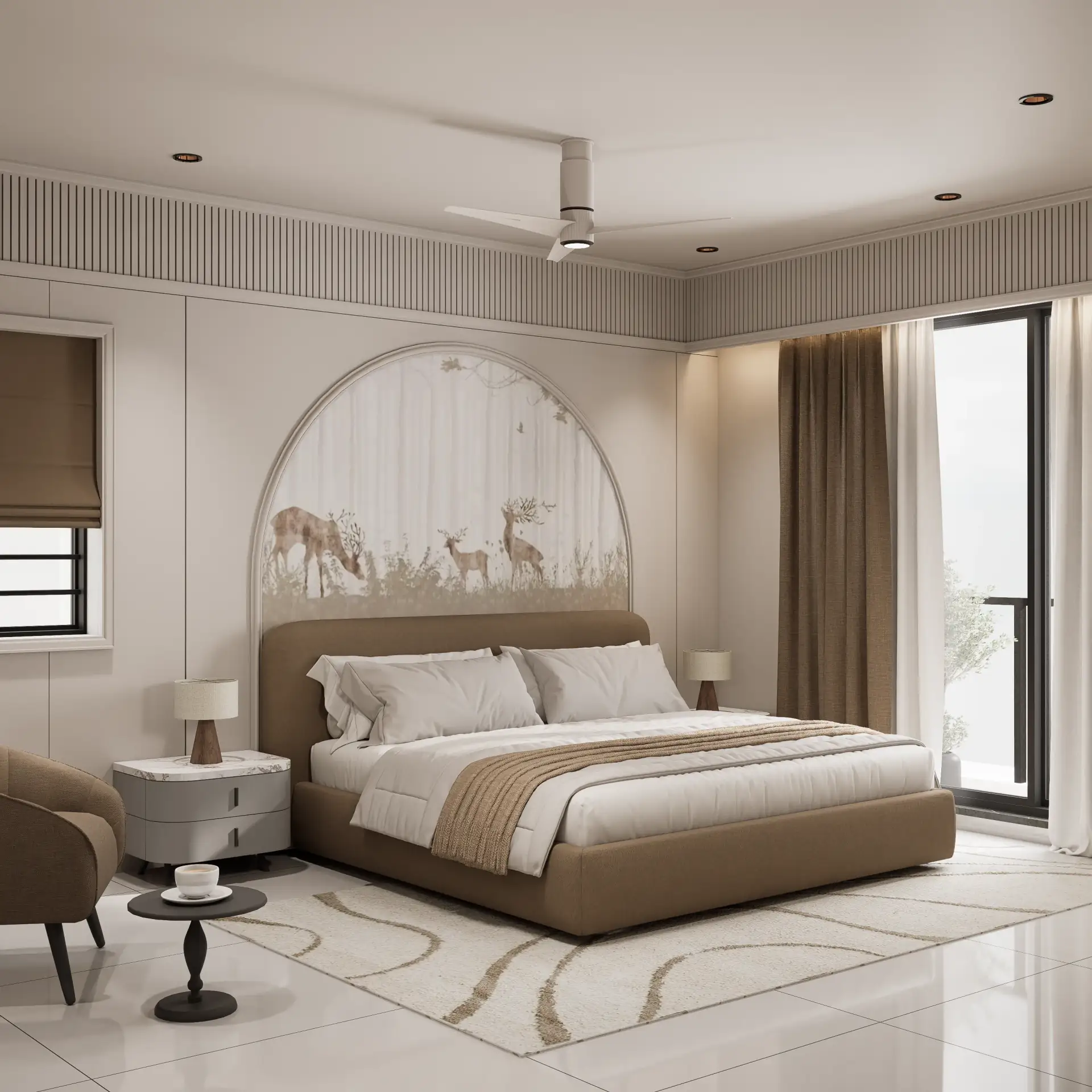
Real estate developers in Rajkot lose an average of 4.2% in project margin for every month a premium unit remains unsold past the plinth completion stage. The primary bottleneck in pre-sales marketing is not capital or location; it is the cognitive gap between 2D architectural blueprints and the buyer's spatial comprehension of luxury volumes. When high-value buyers cannot accurately visualize spatial depths or material finishes, booking cycles stall, tying up critical construction capital.
The Financial Cost of Cognitive Friction in Pre-Sales Marketing
Low-fidelity renders—often generated using generic sketch models and flat, uncalibrated textures—fail to communicate the weight and premium feel of materials like 3200x1600mm vitrified slabs, Italian marble veining, or complex architectural cantilevers. In high-stakes projects like Twin Tower or Silver Heights, selling a 4BHK apartment worth over ₹2 Crore requires absolute spatial certainty.
Traditional architectural elevations fail because they do not account for the real-world light behaviors of the region's intense afternoon sun, leaving buyers hesitant and lengthening booking cycles by up to 9 months. High-fidelity real estate rendering Rajkot solves this spatial conflict by delivering physically accurate visualizations long before the foundation is poured, removing the speculation that delays buyer deposits.
Ray-Tracing and Spectral Light Mapping: The Physics of High-Fidelity Visualization
To achieve photorealism that drives fast bookings, we construct 3D assets to exact geometric tolerances within 2mm margins. In our interior renders for Flora 11, we mapped the living rooms using PBR (Physically Based Rendering) materials. Instead of applying generic diffuse maps, we author custom texture maps with dedicated roughness, normal, and displacement channels.
For instance, the 12mm sintered stone surfaces in our Office Design project utilize a 4K displacement map to capture micro-surface imperfections.
We run render passes through Chaos Corona and V-Ray, utilizing path tracing with up to 16 light bounces. This setup accurately simulates how Rajkot’s ambient light interacts with highly reflective Italian marble and matte-finished veneer panels. By calculating the physical properties of light reflection, we reduce visual artifacts and generate a hyper-accurate representation of the space that builds immediate consumer trust.
Why Offline Path Tracing Outperforms Real-Time Game Engines for Premium Sales
Developers often ask why we do not rely solely on real-time game engines for rapid rendering output. While real-time engines allow immediate fly-throughs, they sacrifice spectral accuracy and subsurface scattering on materials like onyx or custom resin fixtures. For Golden Heights, we evaluated real-time rasterization but rejected it.
The trade-off is render time: a single high-fidelity 8K frame can take 2.5 hours on an RTX 4090 farm compared to 30 seconds in a game engine. However, the physical correctness of path-traced glass refraction and soft-shadow penumbras directly correlates with buyer trust. Real-time engines often produce "floaty" furniture assets that lack contact shadows, breaking the illusion of luxury and causing buyers to question the validity of the design.
Failed Experiments in Automation: The Pitfalls of AI-Generated Textures
In our pursuit of optimizing production timelines for the Sthapatya residential exterior project, we attempted to automate texture generation using neural network upscalers on low-resolution stone maps. The result was a failure. The AI hallucinated non-existent grain patterns on the sandstone cladding, which did not match the physical samples sourced from Morbi quarries. When printed on 10-foot site banners, the scaling artifacts were glaringly obvious.
We also tried using pre-made interior assets for Flora 11's bedrooms, but the European furniture proportions clashed with the regional spatial expectations of Rajkot's premium buyers. We had to scrap 40 hours of render time and return to custom-modeling every loose furniture piece from scratch to ensure exact scale-matching with local interior standards.
The Hard Boundaries of 3D Visualization: Masonry Alignment and Hardware Overhead
High-fidelity rendering is not a fix-all solution for poor construction execution. If a render shows a perfect 3mm grout line on a 3200x1600mm porcelain slab in Silver Heights, but the onsite masonry team works to a loose 15mm tolerance, the physical reality will disappoint the buyer. High-fidelity rendering establishes a benchmark that the construction team must actually meet.
Furthermore, these renders require massive compute overhead. Projects with extensive landscape geometry—such as the exterior public spaces in Twin Tower—require a minimum of 64GB of VRAM to parse the high-poly vegetation models, making real-time onsite modifications impossible. Lastly, high-fidelity renders require finalized electrical and lighting layouts; we cannot produce accurate interior renders without a confirmed ceiling plan, meaning developers must complete their interior architecture before launching pre-sales.
Accelerating Your Project's Booking Cycle in Rajkot and Morbi
To integrate high-fidelity visualization into your next pre-sales campaign, prepare your CAD files, material schedules, and landscape layouts. Craft - The Design Studio partners with developers across Gujarat to transform technical plans into high-conversion visual assets. Contact our design office in Morbi or Rajkot to schedule a technical review of your floor plans. We will analyze your project's light orientation and material specifications to establish a rendering roadmap that targets your specific buyer demographic.