
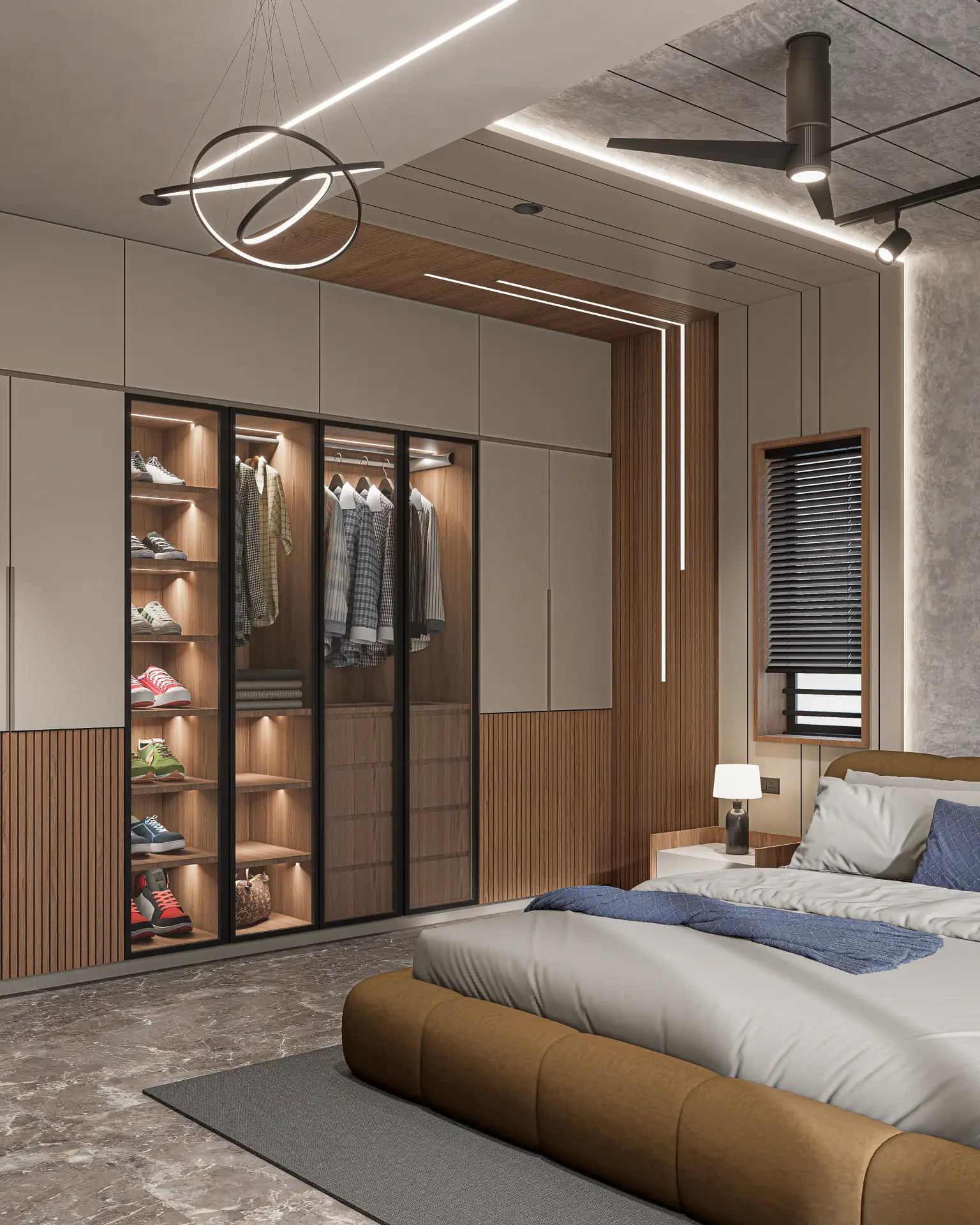
The fundamental challenge in crafting a truly revered pooja room lies not merely in aesthetic selection, but in the rigorous engineering of light, material, and spatial harmony within confined residential footprints. This involves resolving complex interdependencies between material expansion coefficients, precise geometric calculations for intricate carvings, and the optical physics of light diffusion through translucent stone, all while adhering to the immutable principles of Vastu Shastra. Standardized modular solutions invariably fall short, introducing compromises in scale, material integrity, and spiritual resonance. Our work in projects like Golden Heights and Silver Heights in Morbi consistently confronts these precise engineering and design dilemmas, demanding bespoke solutions that transcend conventional approaches to pooja room interior design Morbi Rajkot.
The Core Spatial & Technical Problem: Harmonizing Intricacy with Structural Reality
The aspiration for a grand pooja unit, often featuring deeply carved natural stone and luminous elements, frequently clashes with the pragmatic realities of structural load, spatial constraints, and the unforgiving nature of natural materials. Consider a typical 3000x1800mm pooja wall requiring a 20mm thick CNC-carved marble panel. The sheer weight of such a panel, potentially exceeding 300 kg, necessitates a robust, precisely anchored sub-structure. Furthermore, the integration of backlighting behind an onyx panel, often 18-20mm thick, demands a minimum 75mm cavity depth for optimal light diffusion and heat dissipation, challenging shallow wall recesses. This isn't merely about attaching a slab; it's about predicting material movement, managing thermal stress, and ensuring light uniformity across large translucent surfaces. The margin for error in these bespoke installations is virtually zero, as any deviation in substrate flatness or LED spacing manifests as visible imperfections, detracting from the sacred ambiance. We have navigated these exact challenges in our residential projects, including the detailed planning for the Sthapatya residences, where even exterior elevations influence interior structural decisions for such heavy installations.
Mathematical, Geometric & Material Physics Solutions: Engineering the Divine
CNC Carved Marble: Precision Beyond the Hand
Achieving the intricate patterns characteristic of traditional Indian iconography, or contemporary geometric motifs, on natural stone like Italian Statuario or Vietnam White marble, requires sophisticated CNC programming. Our design process begins with high-resolution 3D modeling, often down to 0.1mm detail. The G-code generated for the CNC machine accounts for the specific tool path, cutter diameter (e.g., 6mm ball-nose for fine detail, 12mm flat-end for roughing), and material hardness. For a typical 20mm deep carving on a 30mm thick marble slab, we calculate tool pressure, feed rates (e.g., 2000 mm/min), and spindle speeds (e.g., 18,000 RPM) to prevent chipping or fracturing, especially around delicate undercuts. The minimum achievable kerf width for deep, intricate patterns without material fatigue is typically 1.5mm. After carving, the surface undergoes multi-stage polishing, often starting with 80-grit diamond pads and progressing to 3000-grit, followed by a final buffing to achieve a mirror-like finish (120-150 gloss units). For our bespoke solutions in Twin Tower apartments in Rajkot, scaling these intricate designs across multiple units required stringent quality control on CNC output and polishing standards.
Backlit Onyx: Mastering Translucence and Illumination
The ethereal glow of backlit onyx is a hallmark of luxury, but its execution is a triumph of optical engineering. We specify natural onyx panels, typically 18-20mm thick, selected for optimal translucency and veining. The critical component is the light source. We utilize high-CRI (Color Rendering Index > 90) LED strips or panels with a consistent Color Correlated Temperature (CCT) of 3000K (warm white) or 4000K (neutral white), depending on the desired mood. The LED pitch (distance between individual LEDs) is paramount; for uniform illumination behind a 20mm thick onyx, a maximum 25mm pitch is essential to eliminate hot spots or visible lines. The cavity depth, as mentioned, is a minimum of 75mm, sometimes extending to 100mm, to allow for proper light diffusion through an intermediary acrylic diffuser (typically 5mm thick opal white acrylic with 70% light transmission). The refractive index (IOR) of onyx, typically around 1.56, influences how light scatters, and the chosen LED intensity (e.g., 1200 lumens/meter) is calibrated to achieve a luminous surface brightness of 150-200 lux. Thermal management is also critical; passive cooling via aluminum profiles for the LED strips prevents premature degradation and color shift over time.
Vastu-Compliant Pooja Unit Layouts: Geometric Precision for Spiritual Alignment
Vastu Shastra is not merely superstition; it’s an ancient science of architecture and spatial geometry. Our designs rigorously integrate Vastu principles from the earliest conceptual stages. The ideal placement of the pooja room is in the Northeast, East, or North direction. The deity's face should predominantly be towards the East or North. We meticulously calculate the precise angular deviation from true North (magnetic declination) for each site, ensuring accurate orientation. Dimensions are often derived from auspicious ratios and multiples, avoiding specific 'inauspicious' measurements. For instance, the height of the main deity platform might be designed to be 108 units (e.g., 108cm or 108 inches) for spiritual significance. Storage should ideally be in the Southwest or West, never above the deity. The design of the pooja unit in our Flora 11 visualizations meticulously incorporated these Vastu guidelines, ensuring not just aesthetic appeal but also energetic correctness.
Structural Trade-Offs & Alternative Comparisons: Plywood vs. Aluminum, Italian Marble vs. Sintered Porcelain
The choice of substrate and finish material profoundly impacts longevity, maintenance, and structural integrity. For luxury pooja room interior design Morbi Rajkot, we often face a critical decision:
- Substrate: Marine-Grade Plywood vs. Aluminum Frameworks: Traditional pooja units often rely on marine-grade BWP (Boiling Water Proof) plywood, typically 18mm thick, for its ease of fabrication and cost-effectiveness. However, in Gujarat's humid climate, even BWP plywood can be susceptible to minor expansion and contraction over decades, potentially leading to hairline cracks in delicate stone or veneer finishes. For the ultimate in stability and longevity, particularly for heavy stone installations or backlit onyx panels, we advocate for structural aluminum box-section frameworks (e.g., 25x25mm or 50x25mm, 2mm wall thickness). Aluminum offers superior dimensional stability, corrosion resistance, and a higher strength-to-weight ratio. While initial fabrication costs are 15-20% higher, the long-term benefits in terms of structural integrity and resistance to environmental factors are undeniable, especially for installations designed to last generations, as seen in our high-end Golden Heights projects.
- Finish Material: Italian Marble vs. Sintered Porcelain: Italian marble (e.g., Carrara, Statuario) offers unparalleled natural beauty, unique veining, and a luxurious feel. Its porosity (0.2-0.5%) requires diligent sealing every 6-12 months to prevent staining, especially from oil lamps or kumkum. It also has a Mohs hardness of 3-4, making it susceptible to scratching. Sintered porcelain slabs (e.g., 3200x1600mm format, 12mm thickness) provide a compelling alternative. With virtually zero porosity (0.05%), superior scratch resistance (Mohs hardness 6-7), and UV stability, they offer extreme durability and minimal maintenance. While they can replicate marble aesthetics with remarkable fidelity, the depth of character and natural variation of genuine marble remain unmatched. The decision often hinges on client priority: absolute authenticity and natural beauty with higher maintenance (marble) or extreme durability and ease of care (sintered porcelain). For the Office Design experience center, where durability and low maintenance were key, sintered porcelain was chosen for high-traffic areas, while natural stone was reserved for executive spaces.
Failed Prototypes & Real Site Lessons: The Unvarnished Truth of Design Iteration
Our journey at Craft - The Design Studio is built on continuous learning, often from what initially appear to be setbacks. We recall an early prototype for a backlit onyx panel where insufficient attention was paid to the LED binning. Despite ordering 4000K LEDs, slight variations in manufacturing batches resulted in a noticeable color shift (a ±150K deviation) across different sections of the panel, creating an unsightly patchwork. The solution involved rigorously binning LEDs at the factory level and implementing a strict 3-step MacAdam ellipse tolerance, ensuring absolute color consistency across all modules. This lesson directly informed the specifications for the Silver Heights project, where seamless illumination was paramount.
Another instance involved a CNC-carved marble backdrop for a pooja unit in a Rajkot residence. The initial substrate preparation, a standard plaster wall, exhibited a 3mm deviation over a 2-meter span. When the 20mm thick marble panel was installed, this unevenness translated into localized stress points, leading to a hairline crack appearing after several months. The rectification involved dismantling the panel, reinforcing the wall with a dedicated 12mm marine-grade plywood backer board, precisely leveled to a ±0.5mm tolerance using laser-guided shims, before re-installing the (replaced) marble. This underscored our non-negotiable principle: the integrity of the finish material is directly proportional to the perfection of its substrate.
These experiences, though challenging, refine our methodology, ensuring that future projects like those envisioned for the Twin Tower development benefit from battle-tested solutions and an unwavering commitment to engineering excellence.
Non-Negotiable Site Tolerances & Budget Thresholds: Setting the Standard
Excellence in pooja room interior design Morbi Rajkot is predicated on adherence to strict technical benchmarks. We enforce the following non-negotiable tolerances:
- Substrate Flatness: A maximum deviation of ±1mm over 3 meters for any surface receiving a rigid finish material (stone, metal, glass).
- Perpendicularity: ±0.5 degrees for all vertical and horizontal elements.
- Grout Gaps: Uniform 1.5mm epoxy grout gaps for stone cladding, ensuring minimal visual interruption and maximum joint strength.
- LED Color Consistency: 3-step MacAdam ellipse tolerance for all specified LEDs to prevent visible color shifts.
- Material Thickness Variation: ±0.5mm for natural stone and ±0.2mm for engineered materials like sintered porcelain.
Regarding budget, a truly bespoke, technically advanced pooja unit featuring CNC-carved marble and backlit onyx, inclusive of structural modifications, premium materials, and specialized lighting, typically starts at a threshold of ₹2,500/sq ft for the unit itself (excluding civil work and general room finishes). This figure accounts for the specialized labor, precise fabrication, and high-quality materials required to achieve our studio's standards. Any significant deviation below this threshold often necessitates compromises in material quality, finish detail, or structural longevity, which we advise against for such a sacred and central space.
How to Execute with Craft - The Design Studio: Your Vision, Engineered to Perfection
At Craft - The Design Studio, with our established presence in Morbi and Rajkot, we transform your vision for a sacred space into a meticulously engineered reality. Our process is transparent, technically driven, and client-centric:
- Initial Consultation & Site Assessment: We begin with an in-depth discussion of your spiritual needs, aesthetic preferences, and a detailed site visit to assess structural capabilities, Vastu orientation, and existing conditions.
- Conceptual Design & 3D Visualization: Leveraging advanced software, we develop detailed 3D visualizations, often to the photorealistic standards seen in our Flora 11 and Sthapatya projects, allowing you to experience your pooja room before a single material is ordered. This phase includes material specifications, lighting schemes, and Vastu integration.
- Technical Design & Engineering Drawings: Our architects and engineers produce comprehensive shop drawings, detailing every joint, every LED placement, every anchor point, and every carving dimension. This includes structural calculations and material stress analyses.
- Material Sourcing & Fabrication: We partner with Gujarat's finest stone fabricators, CNC specialists, and lighting suppliers, ensuring raw material quality and precision manufacturing. Our team oversees every stage of fabrication.
- Installation & Quality Control: Our experienced installation teams work under strict supervision, adhering to the tightest tolerances. Regular site inspections ensure that the execution matches the design intent and technical specifications.
- Handover & Maintenance Guidance: Upon completion, we provide detailed guidance on material care and maintenance, ensuring the enduring beauty and integrity of your sacred space.
To embark on creating a truly transcendent pooja room interior design Morbi Rajkot, one that marries spiritual sanctity with engineering brilliance, contact Craft - The Design Studio. We invite you to schedule a consultation at our Morbi or Rajkot offices to discuss how our expertise can bring your vision to life. Let us engineer your sacred space with precision, passion, and unparalleled technical acumen.