The inherent spatial inefficiencies and aesthetic compromises introduced by standardized, mass-produced furniture within the nuanced architectural envelopes of luxury residences in Rajkot are no longer acceptable. Every millimeter of an interior space, every angle of natural light, and every tactile interaction with a surface demands a level of precision and material fidelity that only custom joinery can deliver. The fundamental problem lies in attempting to force generic forms into specific, often complex, environments, resulting in dead spaces, misaligned sightlines, and a palpable lack of cohesion that undermines the entire design intent.
The Unavoidable Compromises of Generic Furniture in Rajkot Homes
Consider the typical 600mm deep kitchen counter, a global standard, yet frequently inadequate for the vigorous demands of Indian cooking. This singular dimension fails to accommodate the necessary depth for large appliances, preparation space, and the ergonomic reach required for comfort. In projects like our Golden Heights penthouses in Morbi, or the expansive kitchens envisioned for Twin Tower residences, such generic dimensions would not only diminish functionality but also disrupt the visual harmony of a meticulously planned space. The problem extends beyond mere depth; it encompasses vertical clearances, integration with existing architectural features like structural columns or soffits, and the seamless incorporation of utility services. Mass production prioritizes speed and cost efficiency over the bespoke demands of a discerning homeowner, leading to a disconnect between the inhabitant's lifestyle and their living environment.
Mathematical Precision & Material Physics: The Cornerstones of Bespoke Design
Achieving truly bespoke furniture design and decor pieces in Rajkot mandates a rigorous application of mathematical, geometric, and material physics principles. Our design process at Craft begins not with a catalog, but with a laser-scanned digital twin of the site, capturing every deviation and dimension with sub-millimeter accuracy. This allows for parametric modeling where every joint, every panel, and every reveal is calculated to perfection.
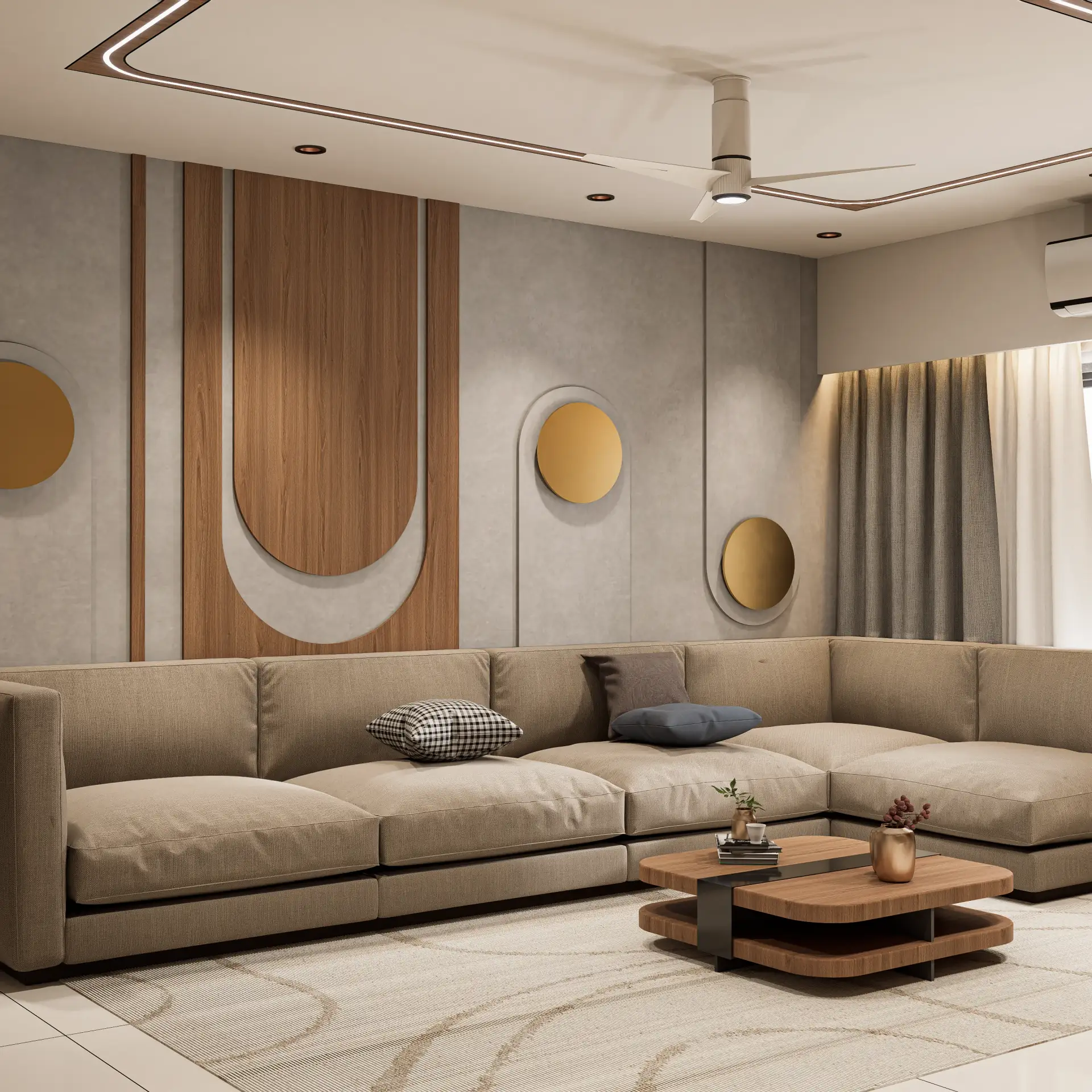
- Geometric Harmony: For instance, in a living room visualization for Flora 11, we might design a custom media unit where the visible face frames adhere to a Golden Ratio proportion (approximately 1:1.618) to the overall length, ensuring an innate aesthetic balance. The internal shelving system might feature an incremental depth progression, perhaps 300mm for books transitioning to 450mm for display items, calculated to optimize both storage and visual flow.
- Load Bearing & Shear Stress: Consider a cantilevered desk in a home office within Silver Heights. The design is not merely aesthetic; it involves calculating the maximum anticipated load (e.g., 50kg for a workstation), the shear stress on the wall anchor points, and the bending moment across the span. We specify a minimum of 18mm Marine Ply for the core, reinforced with structural steel angles embedded into the wall substrate, ensuring a deflection tolerance of no more than 1mm over a 1.2-meter span.
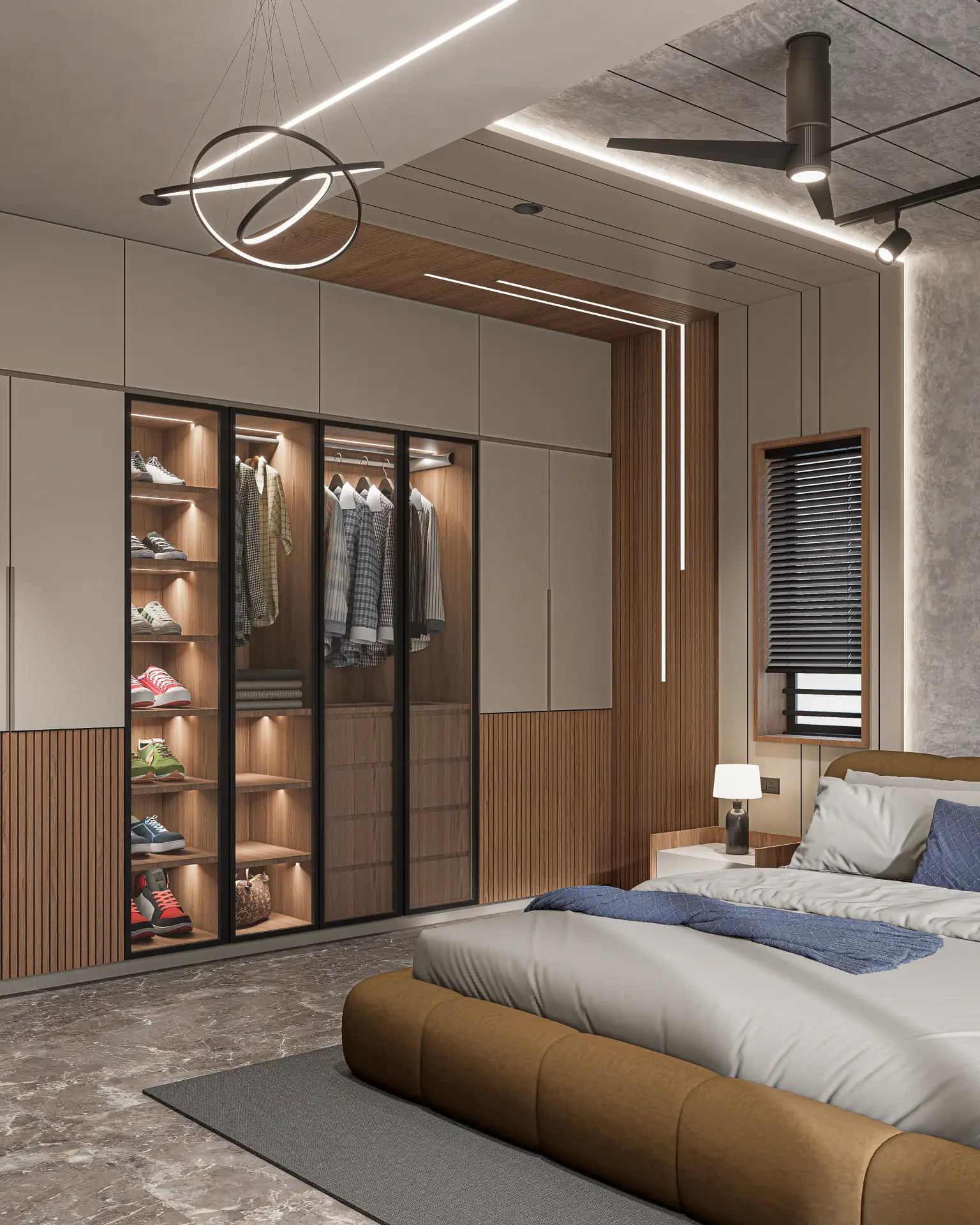
- Light Physics & Material Interaction: The interplay of light is critical for decor pieces. For a glass display cabinet, the Refractive Index (IOR) of the chosen glass (e.g., 1.52 for standard float glass, 1.47 for low-iron glass) dictates how light bends and reflects, impacting the perceived brilliance of objects within. We might specify 4000K LED strips with a CRI of 90+ for accurate color rendition, strategically placed with a 50mm offset from the rear panel to avoid hot spots, employing a frosted diffuser with 70% light transmission to achieve an even glow. For highly polished surfaces, such as a sintered porcelain tabletop (e.g., a 3200x1600mm slab with 12mm thickness), we calculate the reflection coefficient to anticipate glare and ensure ambient lighting balances diffused and direct sources.
- Thermal Expansion & Contraction: Gujarat’s climate, with its significant temperature fluctuations, necessitates careful consideration of material thermal expansion coefficients. A large wooden panel in a wardrobe (as designed for Sthapatya) will expand and contract. We design expansion gaps, typically 2-3mm, concealed by a shadow gap or a flexible sealant, to prevent warping or cracking over time, particularly where different materials, like wood and metal, meet.
Structural Trade-Offs & Material Science: Beyond the Surface
The choice between materials is never arbitrary; it’s a calculated decision based on performance, longevity, and aesthetic intent. At Craft, we delve into the core properties:
- Plywood vs. Aluminum & Steel: While premium BWP/BWR grade plywood (e.g., Greenply, CenturyPly) offers excellent screw retention (up to 200kgf perpendicular to the face) and is suitable for most joinery, structural elements, particularly for heavy-duty storage or cantilevered structures, often demand internal aluminum or mild steel (MS) frames. For instance, in our Office Design projects, ergonomic desking systems might utilize powder-coated MS frames for superior rigidity and slender profiles, capable of supporting concentrated loads of over 150kg without discernible flex, a performance plywood alone cannot match. Plywood, however, remains superior for intricate routing and veneer application.
- Italian Marble vs. Sintered Porcelain: For luxury countertops and feature walls, the debate is profound. Italian Marble, with its unique veining and classic appeal, is porous and susceptible to etching (Mohs hardness 3-4). Its maximum slab size is typically 2.5m x 1.5m, requiring visible joints for larger surfaces. Sintered Porcelain (e.g., Lapitec, Neolith), on the other hand, is non-porous, highly resistant to scratches (Mohs hardness 7-8), UV light, and thermal shock. It comes in large formats (up to 3600x1200mm or 3200x1600mm, 6mm or 12mm thickness), allowing for expansive, near-monolithic surfaces with barely perceptible 1.5mm epoxy grout lines. While Italian marble offers an organic, irreplaceable aesthetic, sintered porcelain provides unparalleled technical performance and consistency, often preferred for kitchen worktops and high-traffic areas in our Twin Tower commercial spaces.
- Solid Wood vs. Veneer vs. Laminate: Solid wood (e.g., Teak, Walnut) offers unmatched natural beauty and durability but is prone to expansion/contraction and is cost-intensive. Veneers, thin slices of real wood bonded to a substrate, offer the aesthetic of solid wood at a lower cost, with greater stability, but are less durable against impact. Laminates (e.g., Merino, Greenlam) are highly durable, scratch-resistant, and cost-effective, ideal for high-wear surfaces but lack the tactile warmth and grain depth of natural wood. The selection is a precise balance of budget, aesthetic, and functional requirements.
Hard-Learned Lessons: From Failed Prototypes to Site Success
Our journey in bespoke furniture design and decor pieces Rajkot has been paved with relentless experimentation and rigorous site lessons. We do not shy away from acknowledging our trials. One early project, a complex wall-mounted shelving unit for a client in Morbi, taught us the critical importance of pre-calculating substrate integrity. We had specified a standard blockboard core for a series of floating shelves, assuming adequate wall support. However, the existing plasterboard wall, while seemingly robust, failed to distribute the point load effectively, leading to a noticeable sag after a few weeks of use. The solution involved a complete redesign, replacing the blockboard with a concealed MS framework anchored directly into the structural concrete, then cladding it with veneered Marine Ply. This incident underscored that the aesthetic vision must always be underpinned by an uncompromising structural reality. Another lesson came from a custom display cabinet for Office Design: initially, we used a standard frosted acrylic for LED diffusion. The result was uneven light distribution and visible hotspots, especially at night. Through subsequent prototyping, we discovered that a higher-density, optically engineered diffuser with a specific micro-prism pattern was required to achieve the seamless, uniform glow desired, even if it added 15% to the fabrication cost. These aren't failures, but critical data points that refine our methodology.
Non-Negotiable Site Tolerances & Budget Thresholds
The success of custom joinery hinges on the precision of the site itself. We maintain non-negotiable tolerances during civil work and subsequent finishes:
- Wall & Floor Planarity: A maximum deviation of 2mm over 3 meters for wall plumbness and floor levelness. Anything beyond this necessitates extensive on-site adjustments, which are costly and time-consuming. Laser levels and total stations are standard tools for our site supervisors.
- Rough-in Accuracy: Electrical points, plumbing lines, and HVAC ducts must be positioned within a 5mm tolerance of the approved drawings. A misaligned switch box by even 10mm can compromise the design of a custom bedside table or a built-in entertainment unit.
- Substrate Preparation: All walls intended for built-in joinery must be adequately prepared, often requiring additional plastering or even a cement board overlay to ensure a perfectly flat, stable surface for mounting and adhesion.
Regarding budget, bespoke furniture design and decor pieces in Rajkot represent an investment in enduring quality and tailored functionality. While mass-produced items might range from ₹500 - ₹1,500 per square foot for basic finishes, high-quality custom joinery, incorporating premium materials (Marine Ply, exotic veneers, branded hardware like Hettich or Hafele, specialized lighting), begins at a threshold of approximately ₹2,500/sq ft and can extend significantly higher depending on complexity, material rarity, and finish sophistication. This threshold is not merely for aesthetics but for engineered longevity, superior functionality, and an impeccable finish that mass production simply cannot replicate.
Executing Vision with Craft - The Design Studio
At Craft - The Design Studio, with offices in Morbi and Rajkot, we translate complex visions into tangible realities. Our process for delivering exceptional bespoke furniture design and decor pieces Rajkot is meticulously structured:
- Initial Consultation & Visioning: We begin by understanding your lifestyle, aesthetic preferences, and functional requirements. This stage is about capturing the essence of your dream space.
- Detailed Site Analysis & Measurement: Our team conducts a comprehensive digital scan of your property, generating a precise 3D model that accounts for every architectural nuance and existing condition.
- Conceptual Design & 3D Visualization: Leveraging advanced software, we develop detailed 3D models and high-fidelity renderings, allowing you to visualize your bespoke furniture and decor pieces within your space. Projects like Twin Tower and Flora 11 demonstrate our visualization capabilities, providing an immersive experience of the proposed design before fabrication.
- Material Specification & Engineering: Every material, from the internal substrate to the final finish, is carefully selected and engineered. We provide transparent documentation on material properties, performance, and sourcing.
- Precision Fabrication: Our network of master craftsmen and state-of-the-art workshops transforms the digital designs into physical pieces, adhering to the strictest tolerances and quality control protocols.
- Expert Installation & Post-Completion Support: Our skilled installation team ensures seamless integration into your home, followed by thorough quality checks and ongoing support to maintain the integrity and beauty of your investment.
Your home in Rajkot deserves more than off-the-shelf solutions. It deserves furniture and decor pieces that are an extension of its architecture and your individuality. It deserves the precision, durability, and aesthetic integrity that only bespoke joinery, engineered by experts, can provide. Engage with Craft - The Design Studio to transform your vision into an enduring reality.